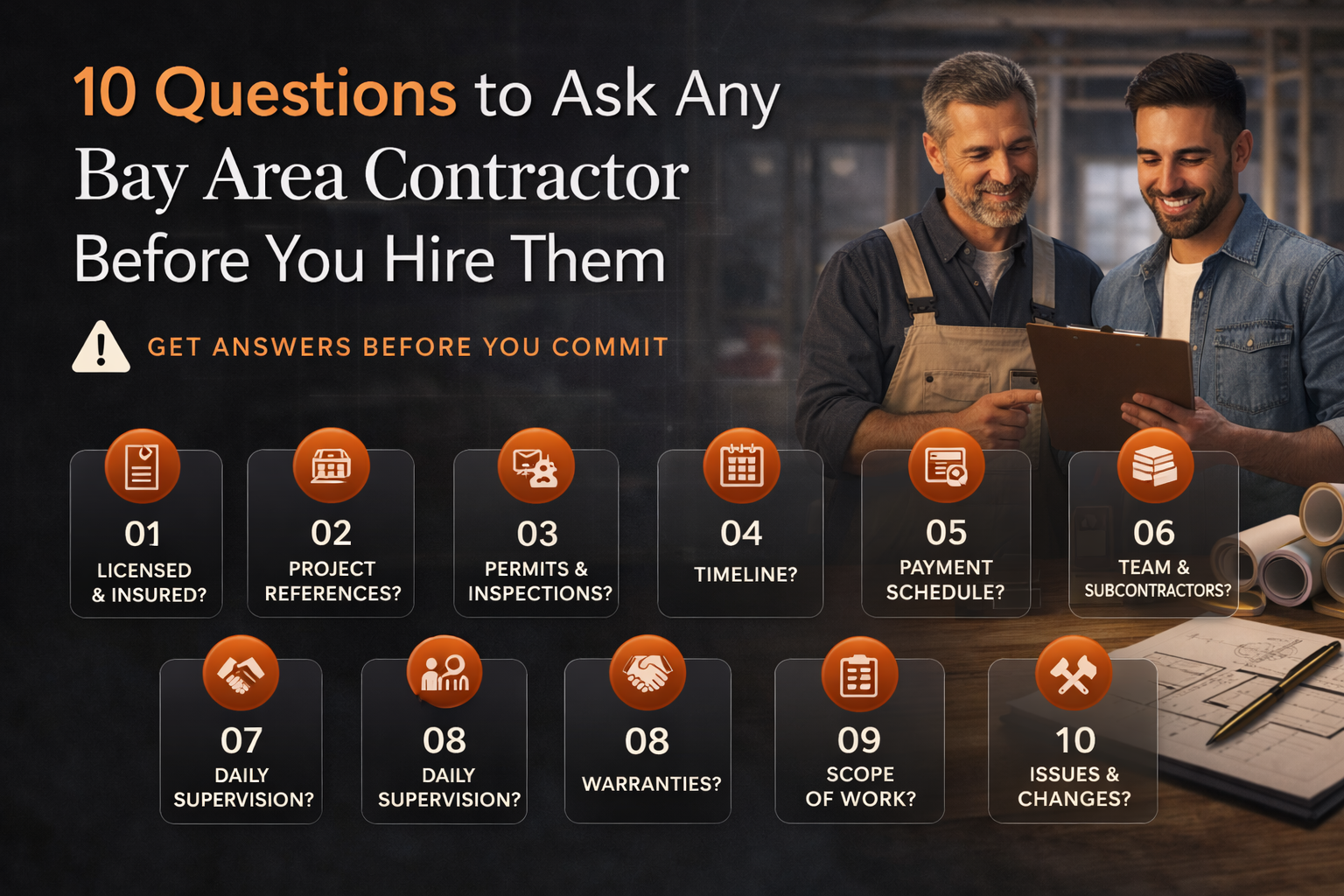
10 Questions to Ask Any Bay Area Contractor Before You Hire Them
The 10 questions every Bay Area homeowner should ask a contractor before signing anything — and what the answers tell you about whether they're worth trusting with your home.
10 Questions to Ask Any Bay Area Contractor Before You Hire Them
Hiring a contractor in the Bay Area is one of the highest-stakes decisions a homeowner makes. A good contractor builds something that lasts, communicates clearly, and leaves you confident the money was well spent. A bad one costs you time, money, and the kind of stress that follows you around for months. The difference between the two is often apparent before the first nail is driven — if you know what to ask.
Here are the 10 questions we think every Bay Area homeowner should ask any contractor before signing a contract — along with what the answers tell you.
1. Are you licensed with the California Contractors State License Board?
This is non-negotiable. In California, any contractor performing work valued at $500 or more in labor and materials must be licensed by the CSLB. You can verify a contractor's license status, classification, and any disciplinary history at contractors.ca.gov — it takes two minutes and tells you a lot.
A valid license means the contractor has passed California's trade exam, carries the required workers' compensation insurance for their employees, and has demonstrated minimum financial standing. It also means there's a legal avenue for recourse if something goes wrong. An unlicensed contractor gives you none of those protections.
What a good answer looks like: They give you their license number immediately and encourage you to verify it. The CSLB record shows an active license in good standing with no disciplinary actions.
2. Are you properly insured — and can I see the certificates?
Licensing and insurance are different things. A licensed contractor still needs current general liability insurance (which covers damage to your property during the project) and workers' compensation insurance (which covers their employees if injured on your job). Ask for certificates of insurance directly from the contractor and verify that coverage is current — not just that they have a policy number.
If a worker is injured on your property and the contractor doesn't have current workers' comp, you can be held liable. If the contractor's crew damages your property and they don't have liability insurance, you may have no practical recourse. This question protects you.
What a good answer looks like: They provide certificates without hesitation. The certificates show active coverage with limits appropriate for your project size.
3. Who will actually be doing the work?
Some contractors are primarily salespeople who subcontract everything to whoever is available. Others have their own crews they've worked with for years. Both models can produce good work, but you deserve to know which one you're hiring.
Ask specifically: will the people who show up to my house be your employees or subcontractors? If subcontractors, have you worked with them before? Are they licensed for their specific trade?
What a good answer looks like: They can describe who will be on your job — by name or at minimum by role — and explain whether they're employees or long-term subcontractors they trust and use regularly.
4. Can you provide references from similar projects in the last 12 months?
References from five years ago tell you very little about the company you're hiring today. Businesses change — crews turn over, owners change, quality goes up and down. Ask for three references from projects similar to yours completed in the last year, and actually call them.
When you call, ask: did the project come in on budget? Was it completed on schedule? How did the contractor handle problems when they came up? Would you hire them again?
What a good answer looks like: They provide references readily. The references answer your calls, speak specifically about their experience, and say yes when you ask if they'd hire the contractor again.
5. Will you pull all required permits for this project?
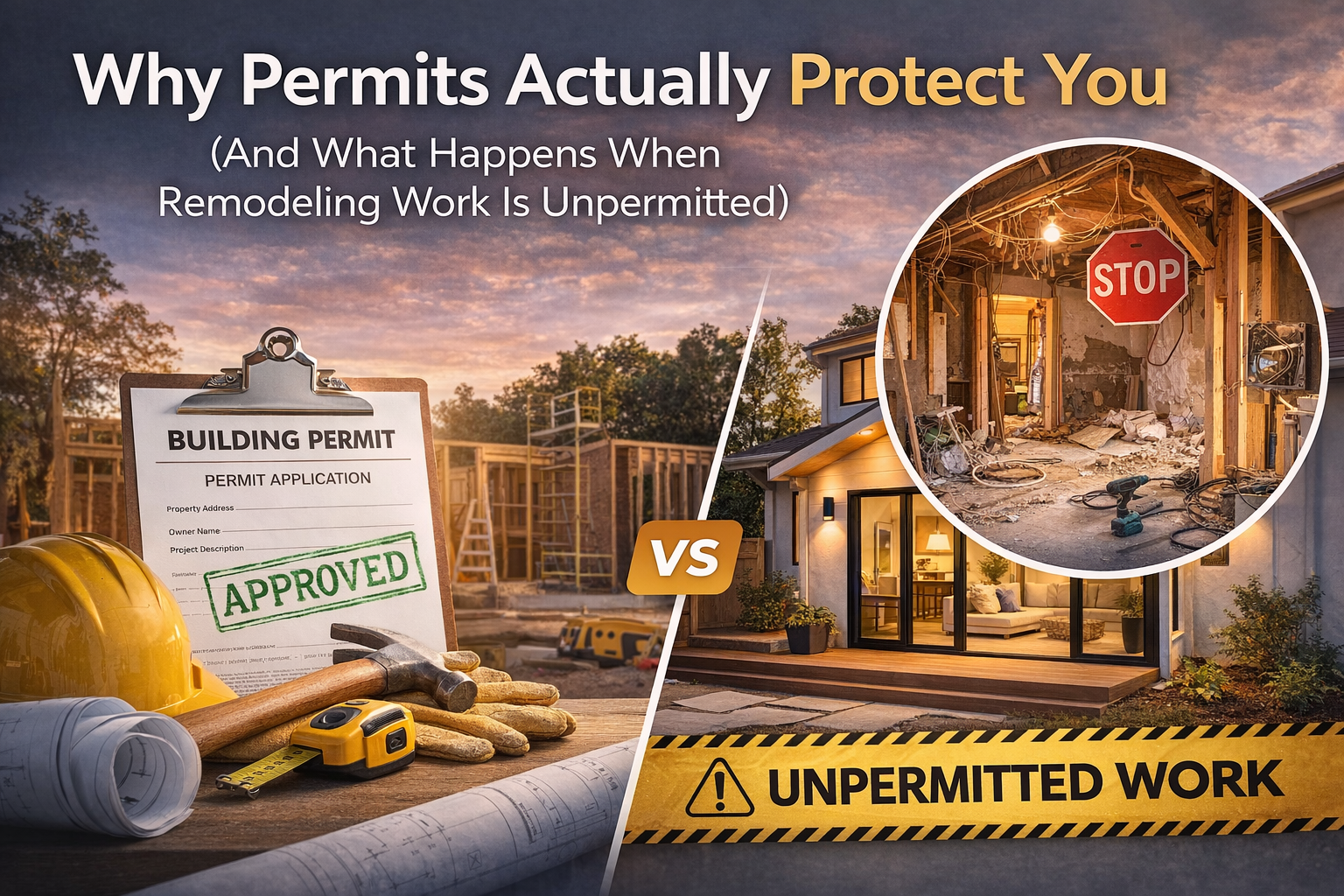
In the Bay Area, most remodeling work of any significance requires permits — kitchen remodels with plumbing or electrical changes, bathroom renovations, room additions, ADU construction, window replacements, and more. Permits protect you: they require inspections that verify the work was done correctly, and they ensure the work is documented in your home's permit history for future sales.
Some contractors offer to skip permits to "save time and money." This is a red flag. Unpermitted work can create serious problems at resale, may not be covered by your homeowner's insurance if it causes damage, and leaves you with no verification that the work was done safely and correctly.
What a good answer looks like: They confirm they'll pull all required permits and explain which permits your specific project requires and why.
6. How do you handle unexpected issues that come up during construction?
In remodeling, unexpected discoveries happen — particularly in older Bay Area homes. You open a wall and find knob-and-tube wiring that needs replacement. You pull up tile and find subfloor rot that wasn't visible before. How a contractor handles these moments tells you everything about how the project will actually go.
The answer you want to hear: they document what they found, show it to you, explain the options and their implications, get your approval before proceeding, and provide a written change order for any additional cost. The answer you don't want to hear: anything that suggests surprises will just appear on your final invoice.
What a good answer looks like: They describe a clear process for identifying, documenting, and communicating unexpected issues — with your approval required before any additional work or cost is incurred.
7. What does your payment schedule look like?
Payment structure tells you a lot about a contractor's financial stability and how much risk they're asking you to absorb. Be wary of contractors who ask for more than 10–15% upfront before work begins — large upfront payments mean you're financing their materials before they've demonstrated anything.
California law limits upfront deposits for home improvement contracts to $1,000 or 10% of the contract price, whichever is less. A contractor who asks for 30–50% before starting is either unaware of this law or is asking you to take on significant financial risk.
What a good answer looks like: A payment schedule tied to project milestones — a small deposit to schedule, payments as work progresses, and a meaningful final payment held until completion and your satisfaction.
8. What is your process for project communication and updates?
Poor communication is the most common complaint homeowners have about contractors — not quality, not cost, but communication. You deserve to know what's happening on your project, when crews will be on-site, when inspections are scheduled, and what's coming next. Ask specifically how the contractor communicates: daily text updates? A project management app? A weekly check-in call?
What a good answer looks like: They describe a specific communication process — not "we'll keep you informed," but a concrete method and cadence for updates throughout the project.
9. How do you handle cleanup and site protection during the project?
Remodeling is inherently messy. What separates professional contractors from unprofessional ones is how they manage that mess — protecting your floors, furniture, and belongings from dust and debris; cleaning up at the end of each workday; and leaving your home in a livable condition throughout the project.
What a good answer looks like: They describe specific practices: plastic barriers to contain dust, floor protection in traffic areas, daily site cleanup, and a final thorough cleaning before project completion.
10. Can I see a detailed, written estimate before I sign anything?
A verbal estimate or a one-line quote is not enough to build a project on. You deserve a written estimate that breaks down labor, materials, and any allowances — clearly enough that you can compare it to other estimates and understand what you're paying for.
Detailed written estimates also protect you against scope disputes during the project. When the work is clearly defined in writing before you start, there's less room for misunderstanding about what was included and what wasn't.
What a good answer looks like: They provide a written estimate broken down by scope category, with clear inclusions and exclusions, before asking you to sign anything.
At Sami & Sons, we're proud to answer every one of these questions clearly and confidently. We're licensed (CSLB), fully insured, permit every project we build, and have spent 15+ years earning the trust of homeowners across Palo Alto, San Jose, Mountain View, and the greater Bay Area. If you're planning a remodeling project or ADU, we'd welcome the chance to answer these questions in person. Call (408) 770-9455 to schedule a free consultation.