
Why Permits Actually Protect You (And What Happens When Remodeling Work Is Unpermitted)
The real consequences of unpermitted remodeling work in the Bay Area — at resale, with insurance, and for your family's safety — and why permits are worth every dollar and day they take.
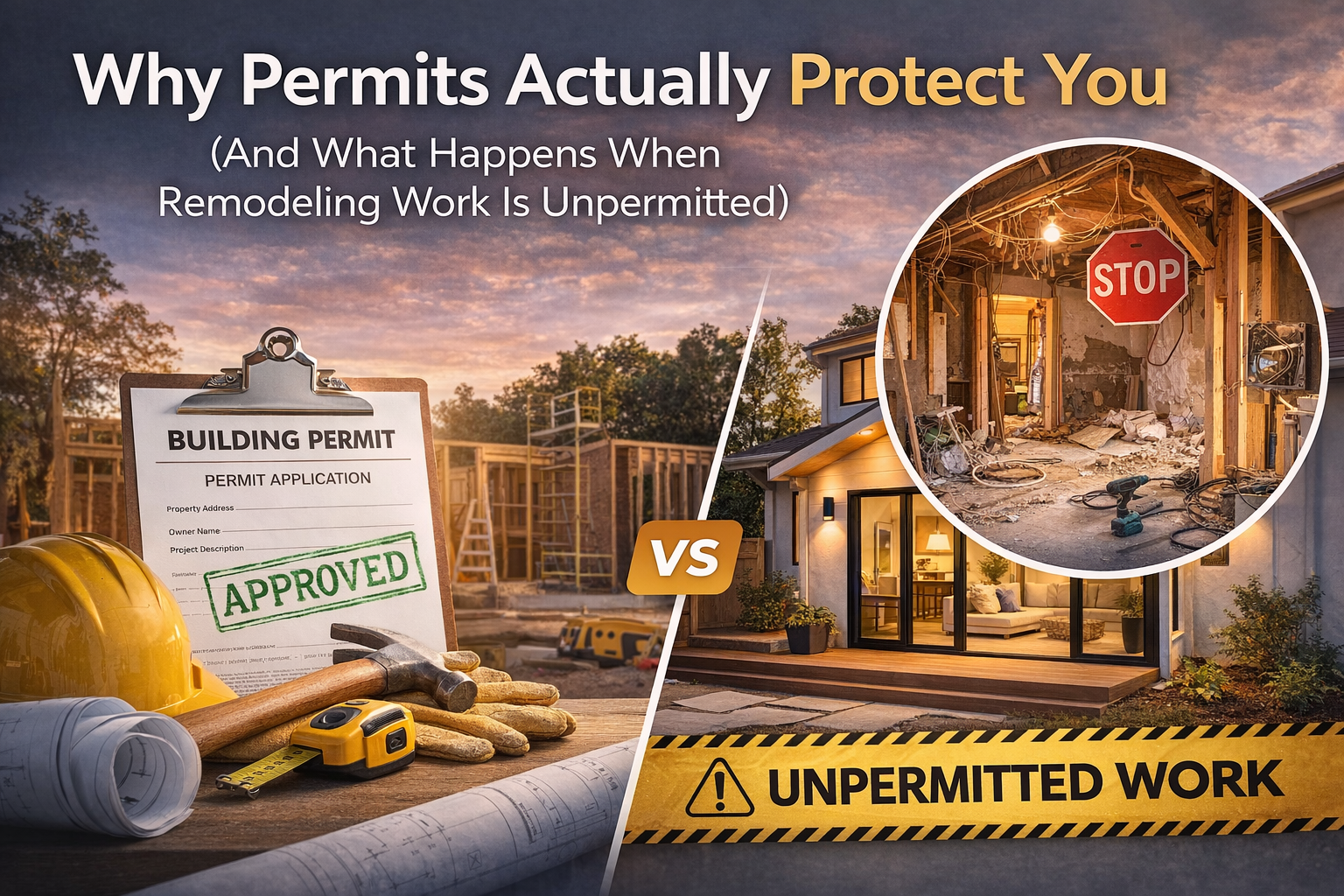
Why Permits Actually Protect You (And What Happens When Remodeling Work Is Unpermitted)
Permits have a reputation problem. Homeowners hear "permit" and think: cost, delay, inspections, bureaucracy. Contractors who skip them sell the idea of permits as unnecessary friction — a cost and time savings passed on to you.
This framing is backwards. Permits don't protect the city. They protect you — as the homeowner, as the person whose family lives in the space, and as the future seller of a property whose history will be examined closely. Here's what unpermitted remodeling work actually costs, in concrete terms.
What permits actually do
A building permit does one thing: it triggers a series of inspections by a licensed city inspector who verifies that the work was done correctly at each critical stage. For electrical work, this means verifying that wiring is properly sized, properly protected, and correctly grounded. For plumbing, it means verifying that drain lines are properly sloped, cleanouts are accessible, and water supply lines are connected without cross-contamination risk. For structural work, it means verifying that beams are properly sized for their span and load, and that connections are adequate for California's seismic requirements.
These aren't paperwork exercises. They're the mechanism by which someone other than the contractor verifies that the work is safe. In a state with California's seismic activity, building code requirements for structural work aren't bureaucratic excess — they reflect real engineering requirements for buildings that need to survive earthquakes.
What happens at resale
This is where the cost of unpermitted work becomes most concrete for Bay Area homeowners. In California, sellers must disclose known unpermitted work. "Known" is interpreted broadly — if you hired a contractor who told you permits weren't needed and you didn't investigate further, you may still be considered to have known or should have known. Real estate attorneys and buyers' agents in the Bay Area are experienced at identifying unpermitted work through permit history searches, and they do this routinely on any significant transaction.
When unpermitted work is discovered in a Bay Area transaction, the outcomes typically include:
- Price reduction: Buyers discount for the cost and risk of bringing unpermitted work into compliance, which often exceeds the cost of the original permitted work because it involves opening finished surfaces
- Delayed close of escrow: Buyers request permits be pulled and work inspected before close, which can take weeks or months and may not even be possible without significant rework
- Fallen transactions: Some buyers walk away rather than take on the liability of unpermitted work
- Lender issues: Many lenders won't fund loans on properties with significant unpermitted improvements
A Bay Area kitchen remodel done without permits to "save" $3,000–$5,000 in permit fees can cost $20,000–$50,000 in price reduction at resale — or can collapse a transaction entirely.
What happens with insurance
Homeowner's insurance policies typically cover damage to structures that were built and modified in compliance with local building codes. Unpermitted work complicates or voids insurance coverage in several ways:
- If a fire starts in an unpermitted electrical installation, your insurer may deny or reduce the claim on the grounds that the work wasn't code-compliant
- If a structure fails or causes injury and the failure can be traced to unpermitted construction, the insurer may have grounds to deny coverage
- An ADU or addition built without permits may not be covered as habitable space under your policy, leaving the structure and its contents uninsured
What happens with safety
Unpermitted electrical work is the leading cause of residential fires in the United States. Improperly sized wiring, wrong-gauge wire for the circuit load, missing ground fault protection in wet areas, junction boxes buried in walls without access — these are the types of conditions that start fires and cause electrocution, and they're what electrical inspections catch. In Bay Area homes where unpermitted work has been layered on top of unpermitted work over decades, the risk can be significant.
Unpermitted structural work — particularly in California's seismic zone — can mean that a wall opening, a second-story addition, or a structural modification was done without engineering review. In an earthquake, the consequences of this can be severe.
The bottom line
Permits take time and cost money. On a significant Bay Area remodeling project, permit fees and the time required for plan review add real cost to a project. But they're not optional for anyone building something they intend to live in safely and sell at full value. The contractors who skip them are passing the risk to you — and the cost shows up eventually.
At Sami & Sons, we pull every permit every project requires. It's one of the non-negotiables we've held for 15+ years of Bay Area remodeling. Call (408) 770-9455 to schedule a consultation for your project — permitted, professional, and done right.


