7 Red Flags That Tell You to Walk Away From a Bay Area Contractor
Seven warning signs that a Bay Area contractor isn't trustworthy — based on 15 years of what we've seen homeowners go through when they hire the wrong person.

7 Red Flags That Tell You to Walk Away From a Bay Area Contractor
In 15+ years of remodeling in the Bay Area, our team has seen the aftermath of a lot of bad contractor experiences. Homeowners who paid large deposits and never saw the contractor again. Projects left half-finished. Work done without permits that created problems at resale. Invoices that doubled from the original estimate with no documented explanation.
These situations have something in common: the warning signs were there before the contract was signed. This guide covers the seven most consistent red flags we've observed — the signals that tell you to slow down or walk away before you're committed.
1. They can't provide a license number or are vague about it
In California, any contractor performing work over $500 must be licensed by the CSLB. A contractor who can't give you their license number immediately — or who says something like "we're in the process of renewing" or "my license is under my partner's name" — is raising a serious red flag.
You can verify any California contractor's license status in two minutes at contractors.ca.gov. An active license in good standing with no disciplinary history is the baseline. If you can't confirm it, you have no protection.
2. They ask for a large upfront deposit
California law caps upfront deposits for home improvement contracts at $1,000 or 10% of the contract price, whichever is less. A contractor who asks for 30%, 40%, or 50% upfront is either unaware of this law — which is itself a concern — or is asking you to take on significant financial risk.
Large upfront payments are the single most common mechanism in Bay Area contractor fraud. Once a contractor has a large portion of your money before work begins, they have very little financial incentive to complete the project on time or to your satisfaction. Tie payments to milestones, keep a meaningful final payment until you've done a final walkthrough and are satisfied, and never pay more than the law allows upfront.
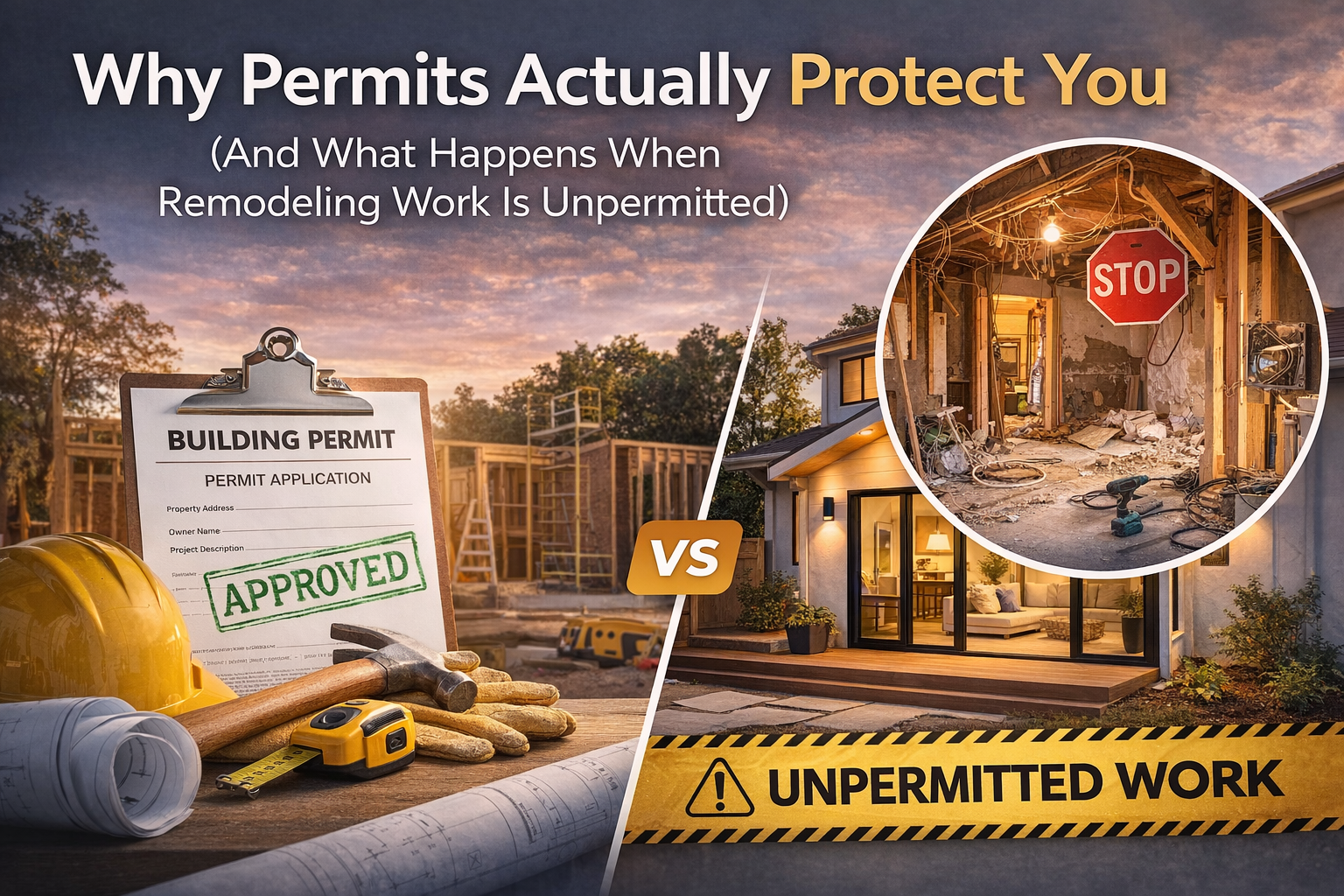
3. They suggest skipping permits to "save time and money"
This is one of the most common things homeowners hear from contractors who are cutting corners — and it should be an immediate disqualifier. Permits exist for good reasons: they require inspections that verify work was done safely and correctly. Unpermitted work puts you at risk in multiple ways:
- It may not be covered by your homeowner's insurance if it causes a fire, flood, or injury
- It creates a disclosure problem when you sell — unpermitted work must be disclosed in California, and buyers' agents know how to find it
- It may need to be demolished and redone at your expense if discovered by the city
- It leaves you with no documented evidence that the work was done to code
A legitimate contractor in the Bay Area will pull every required permit as a matter of course. If a contractor is suggesting you skip them, ask yourself why.
4. The estimate is dramatically lower than everyone else's
In a competitive Bay Area market, there's a floor below which a legitimately licensed, insured contractor with real crews simply cannot price work. If one estimate comes in 40–50% below two or three others, it's almost never because that contractor has found a magical efficiency the others haven't. It's usually because they're planning to use unlicensed labor, cut corners on materials, skip permits, or pad the invoice later with change orders that bring the real cost back up to market.
The most expensive contractor isn't necessarily the right choice either. But when one estimate is dramatically out of step with the others, that's information — and it deserves scrutiny before you sign anything based on it.
5. They can't provide recent references from similar projects
Any contractor who has been doing quality work in the Bay Area for more than a few years should be able to produce three recent references from projects similar to yours without hesitation. If they offer references from years ago, if they're reluctant to provide them, or if the references don't answer your calls — these are meaningful signals.
When you do reach references, ask specifically: did the project come in on budget? Was it completed on schedule? Did the contractor handle problems professionally? Would you hire them again? The answers to these questions tell you far more than any sales presentation.
6. They communicate poorly before the project starts
How a contractor communicates with you during the estimate and proposal process is a preview of how they'll communicate once your money is committed and your walls are open. If they're slow to return calls, vague about project timelines, or hard to get specific answers from during the easy part — it gets worse, not better, once the project is underway.
Good contractors are straightforward about their process, responsive to your questions, and provide clear written estimates without needing to be pushed. These behaviors are habits, not one-time performances. If you're working to get basic information before signing, that's the relationship you're signing up for.
7. There's no written contract, or the contract is vague
California law requires written contracts for home improvement projects over $500. A written contract isn't bureaucracy — it's the document that defines what you're paying for, when it will be done, what the payment schedule is, and what happens if there are disputes. A contractor who is reluctant to put the specifics in writing is a contractor who wants ambiguity — and ambiguity in construction almost always benefits the contractor, not the homeowner.
A good contract clearly describes the scope of work, specifies materials (with brands, models, or grades where relevant), states the project timeline, defines the payment schedule tied to milestones, and describes how change orders will be documented and approved. If the contract you're handed doesn't include these things, ask for them before you sign.
We share this list because we've watched homeowners in Palo Alto, San Jose, and across the Bay Area go through genuinely painful contractor experiences that most of these red flags would have helped them avoid. At Sami & Sons, we aim to be the kind of contractor where none of these questions are uncomfortable to ask. If you're planning a project and want to work with a licensed, insured, permit-pulling contractor who communicates clearly and builds things right, call us at (408) 770-9455.